Great First Lines

This summer, I immersed myself in a community of writers at a place called Star Island.

I learned a lot during those seven days. I learned to figure out what’s at stake. To recognize words that say nothing. To write lean.  To move my readers  forward with every sentence.  That writing is a lot like diving into the Atlantic Ocean at 6:30 a.m.  

I made lifetime friends, and studied with a writer who has mentored me for thirty years – even though we had never met in person until I saw her walking toward the dock.

I’d like to share an assignment we were asked to do in preparation for our week on Star Island. It’s called “Great First Lines.”

Below are a few first lines from my most beloved books. Maybe you’ll nod in agreement, and recognize one of your own. Maybe you’ll be curious and add a book to your reading list. Maybe you’ll learn a bit more about me through the words of writers whose thoughts shaped me.

The house where I grew up, in Durham, New Hampshire, is the only one on the street with a fence surrounding it. That fit. – Joyce Maynard, At Home in the World

My father and mother should have stayed in New York where they met and married and where I was born.  – Frank McCourt, Angela’s Ashes

He told them he loved them. Each and every one of them. – Frank Cullen, Columbine

Our car boiled over again just after my mother and I crossed the Continental Divide. – Tobias Wolff, This Boy’s Life

The Santa Anas blew in hot from the desert, shriveling the last of the spring grass into whiskers of pale straw. – Janet Fitch, White Oleander  

I was on fire. – Jeanette Walls, The Glass Castle

 And two that are not first lines, but great lines nonetheless:

On our first real date, we had drinks at his house, talking nonstop until dawn – and I stayed for forty years. – Diane Ackerman, One Hundred Names for Love  (the book I am reading right now)

“My dear fellow, who will let you?”  “That’s not the point. The point is, who will stop me?” – Ayn Rand, The Fountainhead  (a book I have read at least once a decade since age 18)

And now, an invitation: Would anyone like to share one of their own favorite first lines?

Posted in Uncategorized | Leave a comment

Not Now, I’m Busy!

Hi, how are you?

It’s the cookie cutter, socially appropriate greeting. I say it every time I answer the phone…greet a friend….an acquaintance at work….a waitress at the local diner.

And it has a cookie cutter, socially appropriate answer.

Fine. 

In fact, the person we are addressing could have just lost her job or had a fretful night worrying about a wayward child – but the answer will be the same.

Until lately, that is. We still greet others with, “Hi, how are you?” But as often as not these days, the single word answer isn’t “Fine,” it’s “Busy.” or, “Just busy!” accompanied by a deep sigh, and sometimes a roll of the eyes.

And “busy” doesn’t do much to pave the way for conversation to follow.

“Busy” says, “I’m exhausted.” 

“I’m burdened.”

“I don’t have time to talk to you.”

“My life is so full of important commitments I can’t begin to list them all.”

“You just wouldn’t relate.”

“Busy” stops conversation dead in its tracks.

Indeed, we are busy these days, although it makes no logical sense. My appliances are labeled “high efficiency.” I pay bills automatically and do the banking online. The dry cleaning gets picked up at the door. Communication with friends is accomplished en masse via Facebook. I can watch an hour of TV in 42 minutes, thanks to DVR.

So….why so busy?

Well, I have a theory or two.

Keeping busy is a family value where I come from. To this day, my mom proclaims, “I can’t stand idleness!” as she folds towels, catches up on politics, examines her latest painting, or heads outside to tend her flowers.

At a dinner meeting in Philadelphia last spring, I sat next to an eighty year old named Dan who worked for years as a comedy writer. (Writing for Cheers was one of his better known projects.) Today, he is active – busy – in the national campaign for autism awareness. Dustin Hoffman turned to Dan for help as he prepared for his role in Rainman. Dan shared that keeping busy keeps him relevant, even in his ninth decade of life. And he is convinced that being irrelevant is what makes a person old. Dan’s calendar is fully booked.

Dan would say,and my mom would agree, that keeping busy is like taking a good swim in the fountain of youth.

There is a dangerous edge to all this busy-ness. Being busy for its own sake can signal a preoccupation with the unimportant stuff of life. We keep busy shuffling clutter from one countertop to the next, but the house is never clean. We tend imaginary farms as if our very lives depended on it, but can’t remember the last time we cooked a great dinner from fresh ingredients. We check Facebook hourly, in case somebody had something to say, but are too busy to catch a movie or plan lunch with a  co-worker  who just might become a new friend. We’d rather watch The Biggest Loser than spend an hour working out.

Life clutter crowds out life quality before we know it.

Not intentionally, of course. It’s just that…well, we’re busy!

For me it’s a slippery slope from keeping busy in a healthy way to being overcommitted and overwhelmed. My friend Amy Oscar writes, “Your overwhelm is your teacher,”  but the lessons of my “overwhelm” are the lessons learn slowly. Indeed, I forget them entirely, from time to time.

Yes I can credit (or blame) family values for those overwhelmed moments, but I grew up in the days when the message to women was empowering and clear: You can do it. You can do it all. You can do it all at once. You can do it all at once and do it all well.

And, in fact, I did it all, very well, all at once. My house was clean. My children well dressed and active in dance, scouts, ski club, volleyball, horseback riding, music lessons. My professional evaluations were stellar and colleagues respected my views. I chaired committees at church, served as a scout leader, led a professional organization, picked up a couple of graduate degrees, and regularly donated blood.

I like to think that today I am wiser than the younger version of myself. That I set worthwhile goals and meaningful priorities instead of just trying to do it all. That I have figured out how to live my life in balance. That I recognize my “overwhelm” is, more often than not,  the result of my own choices.

Some days I do okay.

But then I get busy.

Posted in Balance, Busy, Learning, Obsessions, Overwhelmed | Tagged | 3 Comments

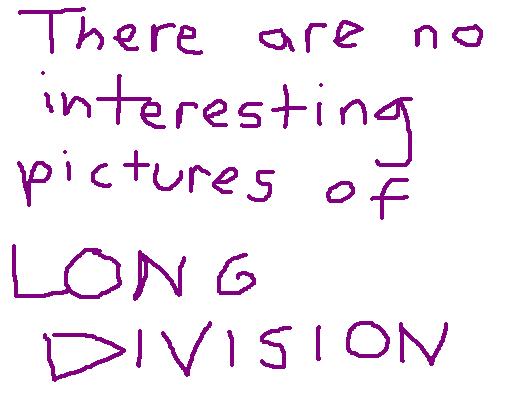
In Defense of Long Division

It is hard to say that anything is certain in life, but I’m quite sure a few things can be crossed off my shopping list for good.

Film.

Carbon paper.

A watch you have to wind every day. Or ever.

This morning I talked with some friends about obsolescence. Even the 20-something in the group was able to remember items from her childhood that have gone the way of answering machines and slide rules. (Although she wasn’t exactly sure what a slide rule was.)

Before long, we realized our list might extend beyond everyday objects. We wondered whether certain skills or topics we learned in school might go on the list. What had we learned that is no longer relevant, or even accurate?

It was easy at first. I learned about nine planets in our solar system. That’s certainly not true anymore, since Pluto’s demotion to a mere dwarf planet.

Today’s Periodic Table of the Elements has 118 neatly organized squares. Back in the 70s, I learned only 103 or so.

In typing class, Mrs. Smith taught us to hit the space bar twice after each sentence.  No more, according to the Chicago Manual of Style. Computers give us proportional fonts, and a single space will do just fine.

Today, most high school students cannot form the entire alphabet in cursive. They only need the letters used to sign their own names. The demise of cursive writing is not a big deal; these kids have been required to use word processing for their assignments since third grade.

I bet business majors don’t spend much time mastering Gregg shorthand these days.

And thanks to graphing calculators, trig classes can delve into sines, cosines, and tangents without plotting tedious points by hand on quadrille paper. 

Which brings us to long division.

With a basic calculator running three bucks or so, and every child over age eight carrying a smart phone, does anybody need to crank out problems like 25,476 divided by 181 the old fashioned way? Does the “upside down L” division sign mean anything nowadays? We are much more familiar with the simple forward slash on our phone or computer screen. And when was the last time you used (or even thought about) the words “quotient” or “remainder”?

In this morning’s conversation, opinions were mixed.

The truth is, even top flight physics students of the 21st century have little notion of the mechanics of long division. They don’t have the time or patience for the trial and error methods that I learned, and probably don’t have to show their work the way I did. Division is simply a step on the path to solving a larger problem.

But despite the long-standing controversy over the “new math” of the last generation, or integration of math skills into “spiraled” curriculum today, I believe there is  something to be said for plain old long division.

Division is a foundation skill, much like writing a basic sentence. The neat pattern of mathematics isn’t complete without an understanding that division is the opposite of multiplication – sort of a repeated subtraction process. As we learned to handle more complex problems, we applied estimation skills. Those remainders we learned about early in the game propelled us to an understanding of decimals and fractions, and how they relate to each other.

And the orderly language of mathematics is, indeed, one representation of the world around us. It’s what those kids are learning in physics class. It is important, I think, to frame those scientific concepts around deep understanding of the basics that underlie them, and help students understand “why.”

There is more to it than hitting the slash key.

My husband Mike takes a different stance. He is convinced that the full bore electronic route to solving time consuming math problems will win out in the end, if it hasn’t already. He went so far as to say that if you handed a traditional long division problem to a passerby  on the street (with that “little tent thing” over the numbers), you would be met with a blank stare, or the remark, “What the hell is this?”

Maybe I am a traditionalist. Maybe it’s idealism. Maybe a bit of naiveté  But some things, I believe, should never go out of style.

Posted in Uncategorized | 9 Comments

This Must Be Something Important – Memoir

In college, all education majors studied the teaching of reading Learning to read is a process, we were taught, so teaching reading was to be undertaken systematically. Phonics, consonant blends and diphthongs were to be introduced according to the assigned methodology before the real business of reading could begin. Then we were to deal with contextual clues and what was called “meaning.”

But it wasn’t that way for me at all. I carried around a stack of soft cover readers all summer as my fourth birthday approached. The books came from Mom’s classroom, from the back cabinet with the tall glass paned doors.

 To me, her classroom was a treasure chest filled with stacks of books, construction paper in every color, new black pencils. The room smelled of crayons and harsh liquid hand soap. I didn’t like the smell much, but mom always said her classroom was beautiful. It anchored the original two-story wing of Stiles Elementary School and had a huge bay window, and a real fireplace built in. I never saw anyone make a fire, but she often gathered her students (she called them her “special children”) there during story time or to recite poems and finger plays.

 That summer, I turned the pages of those books over and over again and carefully studied the pictures on each page.

 The girls on these pages always looked happy. They wore dresses and leather shoes, even for playing outside.

 I wore elastic waist corduroy pants that mom sewed for me; most of the time I put them on backwards. Mom reminded me every day that “the darts go in the back,” but I didn’t know what the darts were. I wore red tennis shoes with rubber caps over the toes, to make them last longer.

 The girls in the books lived where there were sidewalks and other children to play with.

 Our house sat back from a busy road where the speed limit was 50 miles per hour. No sidewalks, just a gravel shoulder between our mailbox and the speeding traffic. No other children lived nearby, at least that I knew of. I preferred to play inside anyway.

  The girls in the books weren’t chubby, and they weren’t afraid of dogs either. I bet they didn’t cry when their hair tangled after washing. Their mothers always smiled and didn’t seem to get tired at all. Their fathers wore ties and white shirts just like the fathers on TV.

One day, as I examined the orderly world on the pages of those books, it occurred to me that I knew what the words said about each picture. I didn’t have to sound them out, or worry about consonant blends or diphthongs. They just made sense. I sat cross legged on the dining room floor and began to pronounce each word out loud.

 Nobody noticed for a while, but then my brother Mike barreled through the back door and raced toward the living room to turn on the TV. He stopped. He listened, without my knowing. He yelled toward the kitchen, “Hey Mom, do you know what she’s doing?”

 After two or three urgings, my mother broke free from her canning jars to come to the doorway. “She can read!” Mike announced. They stood silent for a moment. I continued to say each word, aware now that this must be something important.

Posted in Learning, Memoir, Reading | Tagged , , , | 2 Comments

Green Beans – Memoir

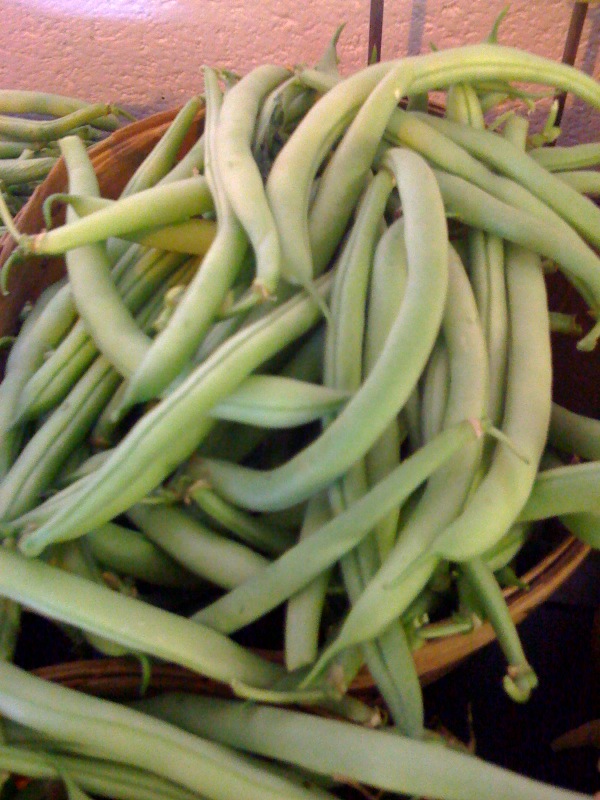
Photo: Hoover’s Farm Market, Lititz, PA July 2011

When I was growing up in Michigan, our family home was situated on five acres. By mid-May every year, Mr. Rathka from up the road pulled around back with his big farm tractor and plowed about half of our land for the garden. When Mr. Rathka arrived to turn the soil, it was a sure sign of spring.  

Dad had been sick for a long time, but somehow, he and Mom worked together to plant Ferry Morse seeds by the hundreds. Straight lines of string marked the rows until the first shoots pushed through. Paper seed packets mounted to wooden stakes identified each section of the garden, assuring that no one confused the cukes with the green peppers. There was an order to it all.

Dad did most of the hoeing, when he could, and by July Mom took on the task of filling her collection of quart-size canning jars with homemade pickles, tomatoes, sweet corn, and an endless supply of green beans.

Even on the hottest days, beans had to be picked and broken into neat one-inch pieces for canning. Usually, Dad picked and carried bushel baskets of beans up to the house before noon. Our screened back porch took on the rich fragrance of warm earth and fresh snapped beans. If any of us kids didn’t look busy, Mom was quick to remind us that there was a mess of beans to deal with.

There was no escape. I was the youngest  and  grew restless with the repetitive task. I rushed through it, most days, so that I could be free to wander back to the solitude of my books or crayons or TV. But my rush job never escaped Mom’s watchful eye and she made sure that I picked through the plastic bowl and broke the largest ones in half again. My older sister Dee, on the other hand, sat contentedly on the porch glider, her petite hands snapping each green pod with precision. On the days my grandma was at our house, she and Dee sat with the bean bowl between them, snapping with a matched cadence and relaxed, satisfied smiles. The two of them somehow understood Mom’s counsel that small, evenly snapped beans would look prettier in the jars.

 As for me, I vowed silently that I would buy my beans from the Jolly Green Giant at the A&P store downtown, like normal people did.

From July right through the beginning of school year, stringing and snapping beans was the melody line in the rhythm of our Michigan summer days. I woke up to the sputtering sound of the big pressure canner on top of the stove. Mom banished me from coming too close, warning that I could be scalded by boiling water as she sterilized jars, or by steam when the canning cycle was done. I sat on my stool near the back door, munching Cheerios and watching from a distance. Mom moved methodically, with precision. She didn’t need a cookbook; she knew exactly what to do.

By mid-afternoon, she had added to the rows of bright jars of vegetables that lined the kitchen counter. Soon enough they would all be stored on basement shelves, but for a few days at least, Mom enjoyed seeing the finished product on prominent display.

 “There’s nothing like a home grown bean,” Mom said time and again, even as she sighed with fatigue after a day spent over the canner or out working the garden.

The other day, I stopped at a farm stand near my house in rural Pennsylvania. There, on the heavy laden wood tables, I spotted heaped baskets of green beans picked fresh that morning. The baskets were the size that Mom and Dad always called a “peck,” made of the same kind of woven wood strips as the baskets I remember, with wire handles on each side.

I moved in close and leaned forward just a little, then picked up a single fresh green bean. I held it to my nose and breathed in, but was disappointed when I couldn’t quite pull out the fragrance that I remembered. I glanced around and seeing no one nearby, snapped that bean in half with one hand.

Again, I inhaled, and this time felt a rush of satisfaction. There it was. The fresh, green aroma touched a place deep in my memory, and lingered on my fingertips. It was the smell of those long ago summers, of our little back porch, of ritual, of family.

Posted in Uncategorized | 4 Comments

Friends and Neighbors

Always the cautious type when it comes to people outside the family, Mom treasures her privacy – especially where neighbors are concerned. She makes friends easily enough, but holds to the adage that “Good fences make good neighbors.”

Neighbors might overhear a family argument on a still summer evening, might borrow a rake and not bring it back, might stop in unannounced. When I grew up and moved to a home of my own, Mom’s advice was to avoid “getting too thick” with the people next door.

It turned out to be no problem, especially after we moved to Olympia Drive. Every house had a three-car attached garage. We might give a cursory nod to another driver as we pulled around the corner but no one felt obligated. We pushed our automatic door openers and retreated into the safe anonymity of central air. We hired lawn services to fertilize and mow the grass. We didn’t feign the slightest interest in small talk as our children rode bikes or rollerbladed in the street.

At most, we talked about real estate. When a house went on the market, our paths might cross at a Sunday open house. Each of us wanted to be sure our own homes were keeping pace with the most desirable upgrades: lavish finished basements, subtle paint finishes, brick paver patios. It made sense to stay competetive, in case we decided to sell in a tough market.

No worry about “getting too thick” with my neighbors there.

As it turned out, three or four of us had husbands who travelled for their jobs, sometimes leaving before dawn on Monday and not retuning until the end of the week. Weekday widows of General Motors and Chrysler and Delta Airlines, we found common ground. No trading gossip over coffee or catching a movie together; just an unspoken agreement to keep our eyes open when one of us was home alone.

On a Tuesday night in July, I jolted awake when the doorbell rang. The clock glowed 2:19. The bell sounded again, and then again.  Roger had left the day before and the kids were both sleeping over with friends. I peeked through the blinds. No car in the driveway; whoever it was came on foot.

Through the narrow window next to the front door, I recognized Kelly from across the street, clad in gym shorts and a t shirt. She clutched a golf club in her hand: it looked like a 5 iron. Shreds of grass clippings and cedar mulch stuck to her knees and shins.

“Call 911.”  She gulped for air and stepped inside.

Thin shoulders trembling under her shirt, she gripped the golf club so tightly her nails dug into the skin of her palm. I put on water for tea.

What happened came out in bits and pieces. With her husband gone so much of the time, Kelly had taken a second job as an ICU nurse. Yesterday she worked a double shift and got home from the hospital around midnight. She hadn’t been asleep long when the alarm went off. The panel near the closet door flashed its message that something had activated a motion detector on the first floor.

A minute passed, then two, with no call from ADT to assure her that it was a system malfunction, or that a strong gust of wind had triggered a false alarm. Kelly picked up the phone to call 911herself. The alarm screamed in her ears. It took a moment to realize that there was no dial tone.

The phone was dead.

The alarm panel kept flashing.

Someone was in the house.

She locked the bedroom door.

On this particular night, all of the husbands on our stretch of Olympia Drive were away – in Oklahoma City, Denver, New York, Calgary, and Geneva. I stood up to double check my own alarm and returned to the kitchen.

“How did you get out?”

Kelly spoke in a whisper. “The window. I grabbed the club and tore out the screen. The porch roof is right there.”

“But how did you get down? I mean, it’s pretty high….”

“Jumped.”

That explained the bark on her knees. She landed in the front flower garden, got up, and ran.

I let the Sheriff deputy in before he knocked and saw three police cars in the street. No flashing lights. No headlights, even. The night was still, the alarm still blaring through Kelly’s bedroom window. She told her story once again for the police report. It was after 3 am when they finished.

A deputy arrived to say that they’d swept the house and checked the woods. The intruder pried the back door open and yanked the phone wires loose. They do that sometimes, he said. But there’s no harm done and things are fine now.

Kelly sipped her tea slowly. I asked if she wanted to stay in our guest room, and was surprised when she accepted. She had to work again at 9, so she would be up and out early. She’d be fine to go back home in daylight, she said, and she had to get the phone fixed.

When I woke up a few hours later, she had already gone.

I never saw Kelly again. No surprise, really. In our neighborhood, people just didn’t “get thick” in that way. I heard that her husband took a job in Connecticut, and a Century 21 sign went up in front of their house.

I went over during the open house one Sunday. Other neighbors nodded approvingly at the custom glass block bar and gourmet kitchen sinks. I stepped out on the deck, alone, and took note of the new back door.

Posted in Friendship, Memoir | Tagged , , | 2 Comments

Guest Blog: Ava Paxton

February 2011

Guest Blogger


When my daughter Sarah was in college, she received a compliment from a family member on a piece she had written. It was not a major project – in fact it could have been a simple note inside a greeting card. The recipient said, “You should be a writer!” Sarah didn’t miss a beat and replied, “I AM a writer!” As her mom, I felt incredible pride in her confidence and clarity at that moment. Last week, Sarah picked up her iPad to find the story below, written (and neatly punctuated) by her own five year old daughter Ava. Enjoy!

The.   Ogr.   Thet.    Got.  Lost.     A.   Family.   Mast.   Oyas.  Shood.   OyasBee.   Too.   Geter. I.   Love.   Mi.  Parents.  A. 5.  Ears.  Ld. Rot.  Thes.   Notb.    And.    Thes.   Es.   The.  Preen.   Es.    Ava. Mea.  Paxton.  She.   Es.  5.  In.    Then.  She.   Es.  Goniy.  Too. Bee.  56789.  We.  Ar.   So. Excited.     For.  Ava.  Too.go     Go.  Too.  School

Posted in Uncategorized | Leave a comment

Lavender Fields

L Zoob 2011

Photo by L. Zoob, 2011

“Ah, to see and know joy in such natural simplicity!” – Iris Lee Underwood, Poet, Essayist, Lavender Farmer

Posted in Friendship | Tagged , | Leave a comment

No Thank You


 I love giving gifts. I will never be one of those shoppers who plucks a handful of gift cards from a carousel at CVS on Christmas Eve. I have never joined the crowd of bargain hunters out before dawn on Black Friday; even if those acrylic sweaters are a great deal, I don’t want to give my daughter one of millions that are just alike.  I prefer to wait for the moment when I spot something that feels exactly right, even if it’s July. The best of those moments happen in unexpected places like a tiny gallery in an artist’s garage or at a table in front of a used book shop. The perfect gifts have a certain spontaneity to them.

But my real obsession isn’t with the purchase, wrapping, or arrangement of those gifts under the Christmas tree.

I am obsessed with the “thank you” that follows. Or doesn’t follow. Whichever.

Now, I am not talking about formal notes penned on monogrammed stationery, although I admit I own personalized note paper suitable for just such occasions. Actually, I am a little surprised that the Hallmark aisle in WalMart still sells thank you notes in neat cellophane packs of eight. They can’t be completely obsolete if WalMart can still turn a buck or two on the notion that we ought to say thanks.

Maybe it’s just me. The summer before 8th grade, i checked Emily Post’s Etiquette out of the library, and read it cover to cover more than once. Emily Post couldn’t have imagined the complexities of 21st century gratitude. Is an e mail enough? What about a tweet, or a post on a Facebook wall? Does the recipient have to actually call to express thanks, or will a text do the trick? Of course a real life “thank you” trumps all of these, but with family spread across seven or eight states at last count, that just doesn’t happen much anymore. But I notice when a thank you comes, in whatever form it takes, and I also notice the ones that go unsaid.

It’s not intentional, but when the tree ornaments are packed away and January rolls around, I find myself creating two neat columns on the left side of my brain. The first is labeled, “Expressed Gratitude for Gift Received and Therefore Qualifies as a Well-Mannered and Civilized Person Deserving of My Continued Affection.” The second? Honestly, this column would include the names of “Those Who Failed to Say Thank You and Who I Will Have a Difficult  Time Forgiving at Least Until the Next Birthday.”

I disguise it, sometimes, as worry about the safe arrival and ultimate appropriateness of my carefully selected gift. I mean, what if Joanne’s package is laying at the bottom of a Fed Ex scrap heap in Tennessee? Maybe Michele’s cute Tommy Hilfiger pj’s were too big and now she is insulted because I must think she is fat.  Maybe Melinda’s beautiful Irish knit sweater was too snug and now she is embarrassed to tell me she gained weight after the last baby came along. Was Adam’s gift was too heavy on clothes and too lean on the fun stuff that little boys like? Was my handmade (fill in the blank) the joke of the entire holiday season? Has it already found its way into the Goodwill box?

But often times, it comes down to this: She got it. She just hasn’t said even the simplest thank you. I’ll show her! No gift next year! No gift ever again! Just you wait and see! 

(In fact, no one has been formally excommunicated from my gift list for quite some time.)

A teacher I loved died a few weeks ago. I took her poetry classes each summer for years, and rearranged everything on the calendar so I wouldn’t miss a class. I struggled, sometimes, with the assignments and I was shy about reading aloud. Everyone else seemed to be so….well, so poetic, as if it came easily to them.  I loved that teacher, with her flowing skirts and gentle voice and bold way of saying, “Yes, write!”

When I heard that Margo had died, I told my husband Mike about those classes. He asked, “Did she know she had that effect on you? That you arranged your summers around her classes? Did you ever tell her?”

I didn’t tell her. I never lingered after class, or sent an e mail, or wrote one of those thank you notes. I wonder if saying thank you would have sparked a great friendship with a gifted woman.  Perhaps it would have come at the precise moment when her heart carried a burden I couldn’t see. But I didn’t say it, so I’ll never know for sure.

Posted in Obsessions | Tagged , , | 2 Comments

Doing Without

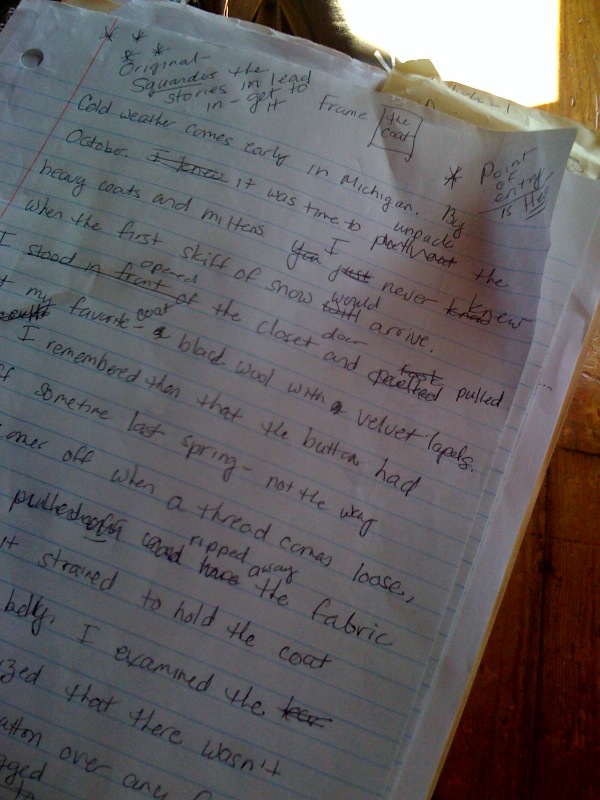
This is a piece I worked on in August 2011, at the Star Island Writers Workshop with writers and teachers Joyce Maynard and Robert Bausch. Joyce taught me the value of short, concice pieces – that sometimes, a rambling beginning squanders other stories that are yet to be written. The lesson in this piece was, “Get to it!”

The story stems from my journey of losing a significant amount of weight over the past few years. People often comment that they couldn’t stand to be deprived of certain foods over the long haul…but when I was extremely overweight, I experienced deprivation of a different kind.

Cold weather comes early in Michigan. By October, it was time to unpack the heavy coats and mittens. I never knew when the first skiff of snow would arrive.

I opened the closet door and pulled out my favorite coat – black wool with velvet lapels. I remembered then that the button had pulled off sometime last spring – not the way a button comes off when a thread comes loose, but actually ripped away the fabric underneath as it strained to hold the coat closed across my belly. I examined the torn spot and realized that there wasn’t space to move the button over any further. Besides, when I tugged the coat around my body, the front didn’t quite come together.

The only option was my raincoat. Its raglan sleeves were more forgiving across the mounds of fat on my back and sides. If I chose carefully, it would fit over a sweater and still button. But the raincoat didn’t have a warm lining, not even the zip out kind. So it couldn’t possibly work for the entire winter.

Or could it?

I like to think it was the thrifty side of me that spoke at that moment, reminding me that a new winter coat was expensive. But the truth is, I realized that a new coat would force me down the rack at Macy’s to the size 20’s…or 22’s.

I took a slow breath.

No. Not yet.

Not till I have to.

Who knows? Maybe it will be a mild winter.

Posted in Uncategorized | 3 Comments